
Table of Contents
Every week I talk to founders and talent leaders who describe hiring fraud as an annoyance. Something their recruiters complain about in standups before everyone moves on to the next agenda item. That framing is dangerously wrong, and it's costing them far more than they realize. The real damage from hiring fraud isn't the fake candidate. It's everything that happened around that fake candidate: the invisible, compounding toll on your team's time, trust, and ability to compete for real talent.
I've been building Tofu in this space for years now, and the more companies I work with, the more I'm convinced that the true cost of hiring isn't financial. It's operational and it wears people down and reshapes how your entire company approaches hiring. Let me walk you through what I mean.
Your recruiters are doing forensic work instead of recruiting
A recruiter opens their ATS to 300 new applications for a senior remote engineering role and immediately they know — they know — that a meaningful chunk of those profiles are fake. But they can't tell which ones just by looking so they start investigating. Cross-referencing LinkedIn profiles against resumes, Googling company names to verify they exist, checking if someone's GitHub activity matches their claimed experience and sometimes even running reverse image searches on headshots. This is detective work, and your team didn't sign up for it.
At Tofu, we consistently see 20-30% fake application rates for remote tech roles. If each fraudulent profile takes even 5-10 minutes to investigate and dismiss, you're losing hours every week per recruiter on candidates who were never real. The time loss is only part of the issue. Over time it changes how recruiters think. When you spend your mornings sifting through fakes, you start approaching every legitimate candidate with suspicion. The energy that should go toward selling your company to a great candidate gets redirected into figuring out if they're even a real person. Gradually your recruiters go from talent partner to gatekeepers, and because that shift happens so slowly, most leaders don't notice until their candidate experience has already started to fall apart.
To put a number on it: the average U.S. recruiter earns roughly $27–$35/hour depending on seniority. If a recruiter spends even 5 hours a week investigating fake profiles — which is conservative at a 20–30% fraud rate, that's $7,000–$9,000 per recruiter per year spent on pure verification work, not recruiting. Scale that across a team of five recruiters and you're looking at $35,000–$45,000 annually in labor costs that produce zero hires.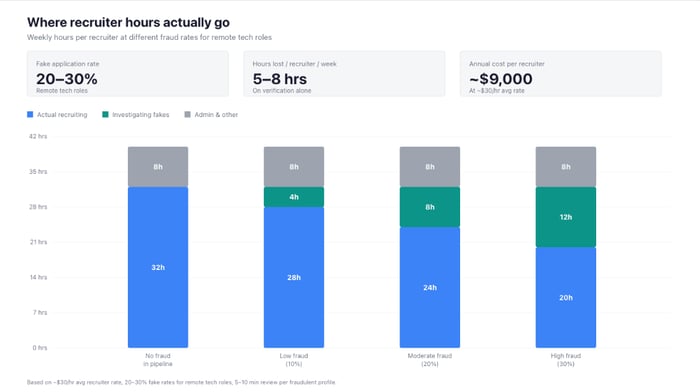
Your hiring managers stop trusting the process
The same pattern shows up with hiring managers. Once a manager sits through a final round with someone who clearly isn't the person from the phone screen, or worse, onboards someone who can't do the job because a proxy interviewed on their behalf, something breaks. They stop trusting the candidates their recruiting team is sending over, they start wondering if anyone actually vetted this person, if the screens were rigorous enough, if recruiting is even catching the obvious stuff before it gets to them.
And that does real damage to the recruiter-hiring manager relationship, which is honestly one of the most important relationships in the entire hiring process. Instead of working together to close a role they start working around each other. The hiring manager wants to review more resumes themselves, they ask for an extra interview round "just to be safe," they get weird about remote candidates. And on the other side, recruiters feel like their judgment is being questioned every time they put someone forward. Nobody says it out loud but the trust just isn't there anymore.
In some cases companies add entire stages to their interview loop purely because of fraud anxiety, not because those stages make hires better but because they make the hiring manager feel like they've got more control over a process they've lost faith in.
That added friction doesn't just slow things down, it makes the experience worse for the 70–80% of candidates who are completely legitimate and now have to navigate a process designed around mistrust. Fraud creates friction, friction damages internal relationships, those strained relationships slow everything down and push away strong candidates, and your competitors close offers while you're still stuck in round three.
It slows your whole team down
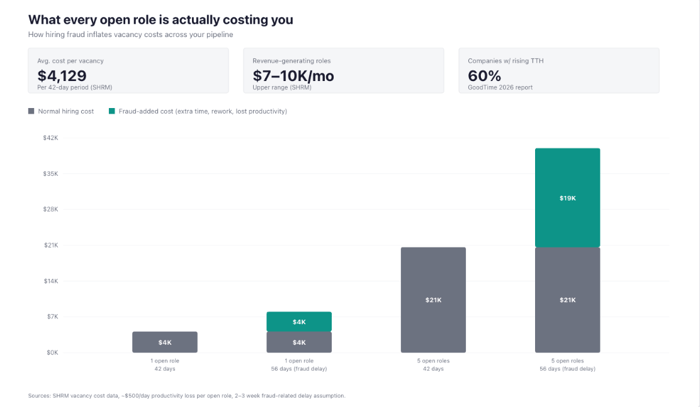
Fraud also doesn't stay contained in the recruiting function. Every open role that takes longer to fill because the pipeline is clogged with fakes is a team running understaffed for weeks longer than it needs to be, which means output drops, product timelines slip, and revenue targets get missed for reasons that never trace back to their actual source. GoodTime's 2026 hiring report found that 60% of companies saw time-to-hire increase last year, and only 1 in 9 managed to bring it down. Fraud isn't the only factor, but it's a multiplier on every other inefficiency in your hiring process.
What makes this particularly hard to address is that the symptoms show up as separate, seemingly unrelated problems: slow hiring, missed deadlines, recruiter burnout, candidate drop-off. Each one gets its own explanation in its own silo. But the through-line connecting them is often the same: your top-of-funnel is compromised, your team is spending its energy on verification instead of evaluation, and the resulting drag is compounding across the business in ways that nobody is measuring. According to SHRM, each unfilled position costs companies an average of $4,129 over a 42-day vacancy period, and for revenue-generating roles that figure can climb to $7,000–$10,000 per month.
It creates an expense drag
Interviewing from North Korea? Expect to fly out of Pyongyang to meet your potential team in SF.
Hiring fraud has pushed companies to the point where they're flying candidates out for in-person interviews and obviously it's not cheap.
20 open roles. 1,000 applicants each. 20,000 total applications.
2% make it past the phone screen → 400 candidates. 1% hit the final round → 200 people on a plane.
At $1,000 a head (flights, Ubers, meals)… that's $200K a year just in travel.
Now throw fraud into the mix.
If even 10% of applicants are faking it, 20 fraudulent candidates make it to final rounds
That's $20,000 spent flying out people who had no business applying
And that doesn't account for recruiter hours, wasted interview slots, or the cost of a bad hire slipping through. For a fully remote company that expense is especially ironic having chosen a distributed model partly to reduce overhead. Costs now rear their ugly head with fraud adding them back into the interview budget.
The fix is simple: catch hiring fraud before anyone books a flight.
The opportunity cost nobody talks about
It’s also worth stepping back from the idea of a bad hire and thinking about the good hire you never made. Every hour spent investigating a fake profile is an hour not spent sourcing or engaging a real candidate, and every interview slot taken by a proxy is one that could have gone to someone who would have made a meaningful impact on your team.
At the same time, strong candidates are moving through other companies’ processes, accepting offers, and disappearing from the market. The longer your pipeline stays polluted, the more likely it is that the person you actually needed chose a company that simply moved faster.
So what do you actually do
This problem is scaling quickly, and treating it as a recruiting nuisance is no longer sufficient. It needs to be approached like any other business risk. Most companies have clear protocols for cybersecurity incidents and financial fraud, but hiring fraud often sits in a grey area where no one at the leadership level fully owns it, even though the costs are just as real.
- Measure the problem. Look at how many applicants are being flagged for suspected resume fraud, how much recruiter time is spent on verification versus actual recruiting, and how time-to-fill compares across roles with high versus low fraud volume. Most teams haven't examined this closely, and when they do, the numbers are often worse than expected. Across companies using Tofu, we flag approximately 30% of inbound remote applications as fraudulent before they ever reached a recruiter's queue, saving teams an average of 20+ hours per week in manual review.
- Assign ownership at the leadership level. Hiring fraud shouldn't live in a grey area between recruiting, security, and ops. Treat it like you would any other business risk, give someone accountability, a budget, and a mandate to fix it.
- Move detection to the top of funnel. Your recruiters got into this work to find and connect with great people, and if a significant portion of their week is spent figuring out who is real, that's both a misuse of their time and a contributor to burnout. Fraud detection should be handled by systems wherever possible, not by humans deep in the hiring process.
- Automate what you can. Manual verification doesn't scale. As fraud grows more sophisticated, your response needs to be systematic,not dependent on individual recruiters playing detective with each application.
Hiring fraud in 2026 behaves like a slow bleed. It shows up in small ways: a recruiter who starts dreading Mondays, a hiring manager who won't sign off without multiple extra rounds, or a strong candidate who accepted another offer weeks ago because your process couldn't keep up. Over time, those small effects compound into something much more costly.
If you've been following along, you already know what we're building at Tofu. We catch fraudulent applicants at the top of funnel so your team never has to deal with them. That's our whole job. If you're feeling any of what I described above, come talk to us.
Jason
FAQs
What is hiring fraud, and how common is it?
Hiring fraud includes fake job applications, fabricated resumes, proxy interviews, and identity misrepresentation during the hiring process. For remote tech roles, fraud rates typically range from 20–30% of all inbound applications, meaning a significant portion of your pipeline may not be real candidates.
How much does hiring fraud actually cost a company?
he costs go well beyond a single bad hire. Recruiter time spent on verification alone can run $7,000–$9,000 per recruiter per year. When you factor in longer vacancies (averaging $4,129 per unfilled role over 42 days), added interview rounds, candidate travel costs for in-person verification, and lost productivity from understaffed teams, the total can easily reach tens of thousands of dollars annually.
Why does hiring fraud slow down the entire hiring process?
Fraud clogs your pipeline with fake applicants, which forces recruiters to spend hours on detective work instead of engaging real talent. It also erodes trust between recruiters and hiring managers, leading to extra interview rounds and added friction. Meanwhile, strong candidates accept offers elsewhere because your process can't keep up.
How does hiring fraud affect recruiter morale and performance?
When recruiters spend a large chunk of their week investigating fake profiles, they shift from being talent partners to gatekeepers. This changes how they approach every candidate — with suspicion rather than enthusiasm. Over time, it contributes to burnout and degrades the candidate experience for the legitimate applicants in your pipeline.
Is hiring fraud a legal liability for employers?
It can be. If a fraudulent hire gains access to sensitive company data, proprietary code, or customer information, the company could face regulatory and contractual consequences. There's also risk around negligent hiring claims if proper due diligence wasn't performed, particularly in industries with compliance requirements.