
Table of Contents
- Breaking Down the Cost of a Bad Hire: Direct and Hidden Expenses
- The Cost Per Hire Formula: How to Calculate Your True Hiring Investment
- Warning Signs of a Bad Hire vs. Warning Signs of a Fraudulent Hire
- The Explosive Growth of Hiring Fraud: 2024-2026 Statistics
- State-Sponsored IT Worker Fraud: The DPRK Scheme Targeting Remote Roles
- Deepfake Interview Fraud: When the Person You Interview Isn't Real
- The Cost Multiplier Effect: How Fraud Turns Bad Hires Into Catastrophic Hires
- Tofu's Fraud Detection Solution
- Final Thoughts on How Much a Bad Hire Costs Your Company
- FAQs
When you calculate the cost of a bad hire, you're usually adding up recruiting spend, onboarding time, lost productivity, and separation costs. That gets you somewhere between $4,700 and $28,000 depending on the role. But a fraudulent hire operates on a completely different scale. The person who passed your background check with a fabricated identity, sailed through video interviews using AI-generated faces, and logged into your systems on day one wasn't a hiring mistake. They were a security incident waiting to happen. The cost isn't measured in wasted recruiter hours. It's measured in insider threat containment, OFAC penalties, data exfiltration damage, and the kind of legal exposure that doesn't show up in any cost-per-hire calculator until you're already deep into incident response.
TLDR:
- A traditional bad hire costs $4,700 to $28,000 in wasted recruiting and lost productivity, but a fraudulent hire costs an average of $701,500 per insider threat incident plus OFAC penalties starting at $50,000 per violation.
- Fraudulent hire warning signs appear at application: resume metadata manipulation, IP anomalies, location spoofing, and deepfake video interviews. Bad hire red flags only surface after onboarding.
- By end of 2024, 17% of hiring managers encountered deepfakes in interviews, and North Korean IT worker schemes generated an estimated $800 million by placing operatives in remote roles.
- Standard cost per hire calculators don't account for fraud-specific outcomes like incident response, data exfiltration, or regulatory violations. The catastrophic tail risk compounds after day one.
- Tofu's FraudDetect screens applicants across 40+ signals against 4B+ data points to catch synthetic identities and DPRK IT workers, while DeepDetect monitors live interviews for AI-generated manipulation and proxy swapping before offers go out.
Breaking Down the Cost of a Bad Hire: Direct and Hidden Expenses
Most hiring mistakes look expensive on paper. The real number is worse once you count everything.
The U.S. Department of Labor estimates a bad hire costs at least 30% of that employee's first-year salary. SHRM puts the average cost per hire alone at $4,700, and that's before a single day of lost productivity hits the books. Direct costs include job postings, recruiter time, background checks, and onboarding. Hidden costs are where the damage compounds: wasted manager hours, team morale, missed revenue targets, and the eventual cost of starting over from scratch.
A fraudulent hire skips straight to a different category of loss entirely. You're no longer calculating wasted onboarding time. You're calculating incident response, legal exposure, potential OFAC violations, and the cost of containing an insider threat who had full system access from day one.
The Cost Per Hire Formula: How to Calculate Your True Hiring Investment
The standard SHRM cost per hire formula looks like this:
Cost Per Hire = (Internal Recruiting Costs + External Recruiting Costs) / Total Hires
Internal costs cover recruiter salaries, time spent interviewing, and referral bonuses. External costs include job board fees, agency fees, background checks, and assessments. For a company making 50 hires a year with $235,000 in total recruiting spend, that's $4,700 per hire, right at the SHRM benchmark.
That formula has a ceiling, though. It captures what you spent to fill a role, not what a bad hire costs after day one. A more complete version adds indirect costs:
Cost Category | Examples |
|---|---|
Direct recruiting | Job postings, agency fees, background checks |
Internal labor | Recruiter and manager hours per hire |
Onboarding and training | Orientation, equipment, ramp time |
Lost productivity | Vacancy gap and underperformance period |
Separation costs | Severance, legal, offboarding admin |
Once you run the full calculation, $4,700 becomes a floor. For senior roles, total costs routinely exceed $28,000. Add a fraudulent hire into that math and the formula breaks entirely. No spreadsheet has a line item for a security incident.
Warning Signs of a Bad Hire vs. Warning Signs of a Fraudulent Hire
Most bad hire red flags show up after the offer letter. A fraudulent hire shows up before the first interview, if you know what to look for.
Traditional warning signs surface during or after hiring: skills that don't match interview claims, cultural misalignment within weeks, vague references, missed deadlines in the ramp period.
Fraud-specific signals appear earlier:
- Resume metadata inconsistencies or file manipulation
- Social accounts mismatched to the applicant's stated identity
- IP or device signals suggesting location spoofing
- Lip sync delays or facial inconsistencies in video interviews
- A different person appearing across interview rounds
A bad hire costs time and money after day one. A fraudulent hire costs security, legal exposure, and trust, and the warning signs were there at step one.
The Explosive Growth of Hiring Fraud: 2024-2026 Statistics
By end of 2024, 17% of hiring managers encountered deepfakes, up from 3% the year prior. North Korean IT worker rings generated an estimated $800 million in 2024 placing operatives inside remote technical roles. Gartner projects 1 in 4 candidate profiles will be fake by 2028, per Moody's research on hidden fraud trends.
Human review alone won't catch it.
State-Sponsored IT Worker Fraud: The DPRK Scheme Targeting Remote Roles
The Justice Department didn't call it a hiring problem. They called it a national security threat.
North Korean operatives have spent years systematically placing IT workers inside American companies. The playbook is consistent: stolen or fabricated identities, VPNs to mask location, professional facilitators in the U.S. running laptop farms, and deepfakes layered over video interviews to pass human review. By May 2024, the FBI and Treasury Department had traced the scheme to over 300 affected companies, with operatives generating hundreds of millions to fund weapons programs.
These aren't unqualified candidates who exaggerated a resume. They pass technical screens. They ship code. They stay quiet, collect paychecks, and in some cases, exfiltrate data or install backdoors before anyone notices. The goal was never the job. The job was the access.
For companies in fintech, crypto, healthcare, and infrastructure, the exposure goes beyond data theft. Hiring a sanctioned national is an OFAC violation, meaning regulatory consequences independent of whether the operative caused visible harm.
Standard background checks don't catch this. The identity is real enough to pass surface-level review, which is exactly why it works at scale.
Deepfake Interview Fraud: When the Person You Interview Isn't Real
The KnowBe4 incident is now well-documented: a software engineer who passed every screen, cleared a background check, and sailed through a video interview loaded malware onto their workstation on day one. The person they interviewed was not the person who showed up.
Deepfake tools that replace a face and voice in real time are cheap, widely available, and outpacing human detection. Proxy interviewing compounds this further. A candidate hires a technical stand-in for the interview, then shows up on day one as themselves, unable to do the job. No deepfake required.
The fix is continuous identity verification across the entire funnel, from application through offer.
The Cost Multiplier Effect: How Fraud Turns Bad Hires Into Catastrophic Hires
A traditional bad hire costs money. A fraudulent hire costs everything.
The $4,700-to-$28,000 range covers wasted recruiting cycles and lost productivity. Fraudulent hires operate on a different scale. A single insider threat incident averages $701,500 in total damages, according to the Ponemon Institute. Add an OFAC violation and you're looking at civil penalties starting at $50,000 per count. Data exfiltration, ransomware deployment, reputational fallout? None of those have a line item in the standard cost per hire formula. Fraud detection is risk mitigation against outcomes that don't appear on any hiring cost calculator until it's too late.
Tofu's Fraud Detection Solution
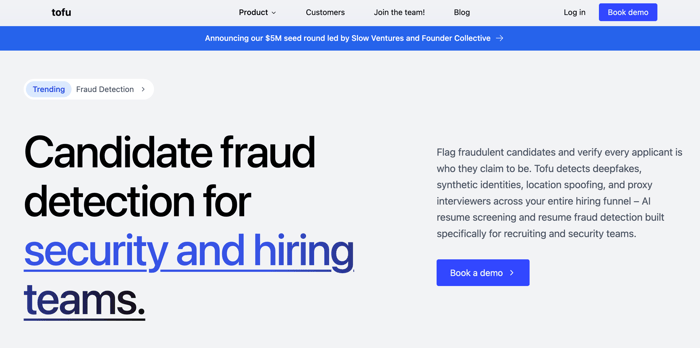
Tofu was built for recruiting fraud, not repurposed from fintech tooling. FraudDetect screens every applicant across 40+ signals at application, validates identity against 4B+ data points and a proprietary Fraudbase built from 5M+ analyzed profiles, and catches synthetic identities, DPRK IT workers, location spoofing, and proxy interviewers before a recruiter opens the file.
DeepDetect takes over at the interview, monitoring live video for AI-generated manipulation by analyzing lip syncing, eye movement, facial construction, and voice patterns in real time. Proxy swapping across rounds gets caught before an offer goes out.
A bad actor flagged by one of Tofu's 170+ customers like Lithic gets flagged across the entire network via our fraud API. Fraud rings don't get a second run.
Human review can't run 40 signals on every applicant. Tofu can.
Final Thoughts on How Much a Bad Hire Costs Your Company
The average cost per hire sits around $4,700, but fraud multiplies that into six-figure incident response and regulatory violations. A bad hire shows up after onboarding. A fraudulent hire shows up in your application data with IP anomalies, metadata manipulation, and social account mismatches before a recruiter sees the resume. Human review alone won't catch what fraud rings engineer to bypass it. If you're seeing suspicious patterns in your applicant flow, we're happy to share what we're learning.