
Table of Contents
- Why We're Talking About This
- The Sterile Identity Problem
- What the Data Shows
- Why Everyday Platforms Are So Predictive
- Social Media: Strong, But Not Equal
- Developer Platforms: A Surprising Split
- Freelance Platforms: The Counterintuitive Signal
- What This Means for Your Recruiting Security
- The Arms Race Continues
- FAQs
Why We're Talking About This
We've spent the last two years building one of the best applicant resume fraud detection tools for recruiting, amassing one of the largest fraudulent candidate datasets in the industry. Over 5M applicants. Billions of data points. Hundreds of signals cross-referenced against confirmed fraud outcomes.
We recently completed a deep analysis on a category of signals we hadn't seen anyone in the industry talk about before, and the results were so striking that we had to share them.
The finding? The strongest predictor of whether an applicant is real has almost nothing to do with their professional profile. It has everything to do with whether they live a life outside of work.
The Sterile Identity Problem
Fraudulent candidates - whether they're identity thieves, North Korean IT operatives, or professional impersonators - all share the same fundamental constraint: they need to build a believable identity quickly and cheaply.
That means they focus exclusively on the accounts that matter for getting hired. A LinkedIn profile. A professional email. Maybe a GitHub. They build exactly what a recruiter expects to see, and nothing more.
The result is what we call a "sterile identity." It checks the professional boxes, but it's missing something that every real person has: a digital life.
Think about your own online footprint. You probably have subscriptions, apps you use daily, accounts tied to your hobbies and routines. These aren't things you created to get a job. They're things you created because you're a person who lives in the world.
Fraudulent identities don't have them. And that absence turns out to be one of the most powerful signals we've ever measured in resume fraud detection.
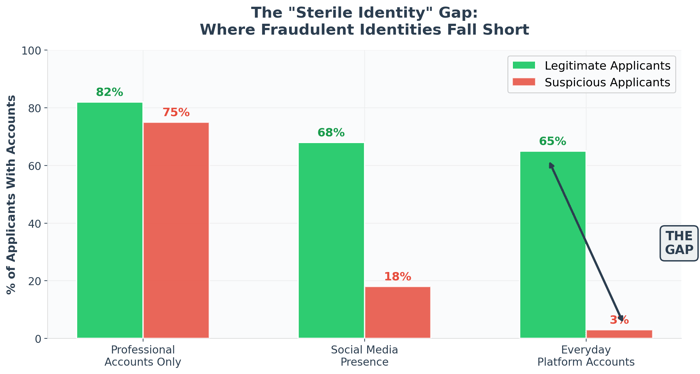 Account types and their strength in resume fraud detection
What the Data Shows
We analyzed platform presence across thousands of applicants who had already been scored by Tofu's fraud detection engine. We grouped accounts into categories - everyday consumer platforms, social media, developer tools, and freelance marketplaces - and measured how each category correlated with our fraud ratings.
The results were dramatic.
Applicants who had accounts on everyday, non-professional platforms - the kind of services people use in their personal lives - were overwhelmingly more likely to be legitimate. Clean rates for these applicants ranged from 82% to 95%, compared to a baseline of just 50.3% across the full population. Some platform categories showed clean rates above 90%.
| Signal Category | Clean Applicant Rate | vs. Baseline (50.3%) |
|---|---|---|
| Everyday Platforms | 87.0% | +36.7 pts |
| Social Media | 52.6% | +2.3 pts |
| Developer Platforms | 42.2% | -8.1 pts |
| Freelance Marketplaces | 23.5% | -26.8 pts |
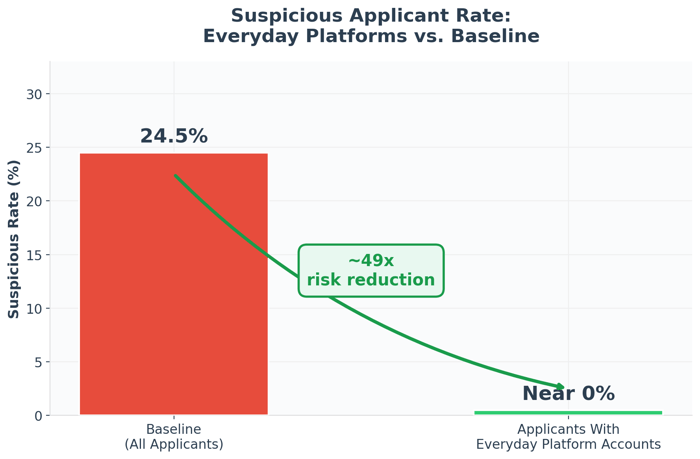
But the real story is on the other side of the ledger. When we looked at suspicious rates, certain everyday platform categories showed rates at or near zero. In plain terms: among applicants with accounts on specific everyday platforms, we found virtually no confirmed fraud. Not low fraud. Zero fraud.
That's an infinite risk reduction factor - and it held across sample sizes large enough to be statistically meaningful.
Why Everyday Platforms Are So Predictive
The logic is intuitive once you see it. Non-professional platform accounts are powerful legitimacy indicators for three reasons:
They serve no professional purpose. Nobody creates an account for their hobbies or daily routines to pass a job screening. These accounts exist purely because a real person has real habits, interests, and routines.
They require genuine engagement. Usage histories, activity patterns, and engagement streaks all accumulate over time through actual use. You can't fake years of organic platform activity the same way you can fabricate a LinkedIn work history.
They're expensive to simulate at scale. A fraud operation running hundreds of fake identities can spin up LinkedIn profiles and email addresses efficiently. Building out convincing everyday platform footprints across dozens of services for each identity? That's a cost-benefit equation that doesn't pencil out.
This is what makes the "humanness" signal so durable - it's inherently resistant to the scaling economics that make other forms of fraud so easy.
Social Media: Strong, But Not Equal
Social media accounts also showed meaningful discrimination power, though the strength varied significantly by platform. Some social platforms showed clean applicant rates above 50% with suspicious rates dropping to low single digits - representing a significant improvement over baseline.
The key insight here is that not all social platforms are created equal as fraud indicators. Some are far easier to fabricate or purchase than others, and our data reflects that reality. The platforms that are hardest to fake - the ones that reward genuine engagement and long-term use - consistently produced the strongest signals.
Developer Platforms: A Surprising Split
Developer platforms told a more nuanced story. While some developer accounts correlated with higher clean rates, one of the more commonly used coding platforms showed almost no discrimination power at all. Suspicious applicants were nearly as likely to have accounts on that platform as clean applicants.
This makes sense when you consider the adversary. Many fraudulent applicants targeting technical roles are, in fact, technically capable - they're just not who they claim to be. They maintain real developer accounts because they actually do code. The presence of a developer profile tells you someone can write code. It tells you very little about whether they're operating under a real identity.
This is a critical distinction for companies that rely heavily on technical screening platforms as a proxy for legitimacy. Technical skill verification and identity verification are fundamentally different problems, and conflating them creates blind spots.
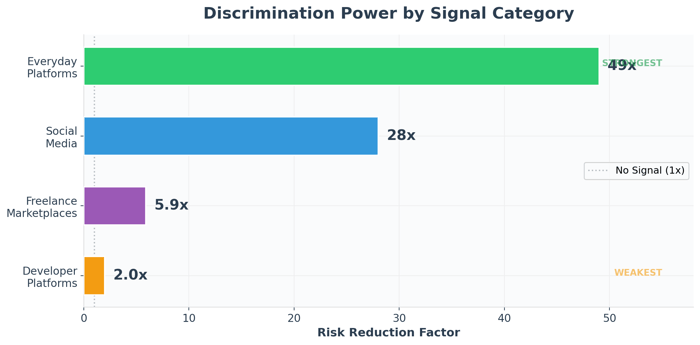 Resume fraud detection - categorical power
Freelance Platforms: The Counterintuitive Signal
Freelance marketplace presence showed a moderate positive signal for legitimacy - perhaps counterintuitively, given that some fraud operations are known to recruit through these platforms. Clean applicants were roughly 5-6x more likely to have freelance accounts than suspicious ones.
Our interpretation: while freelance platforms can be part of the fraud ecosystem, having a genuine, established presence on them still correlates with real economic activity and real identity. The signal isn't as strong as everyday platforms, but it adds value as part of a composite score.
What This Means for Your Recruiting Security
If you're evaluating applicant fraud detection tools - or building internal processes to manage this risk - the "humanness" signal has several practical implications:
Surface-level checks aren't enough. Resume fraud detection tools that only verify whether an email is deliverable, a phone number is active or even sometimes analyze IP addresses are operating at the wrong layer. The most predictive signals sit deeper in a person's digital footprint, in the places where real life and digital identity intersect.
Professional profile signals have diminishing returns. As fraudulent actors get more sophisticated at mimicking professional identities - buying aged LinkedIn accounts, building convincing GitHub histories - the discrimination power of professional-only signals will continue to erode. The advantage shifts to signals that are inherently harder and more expensive to fake.
Composite and probabilistic scoring matters. No single signal is a silver bullet. The power of the humanness signal comes from combining dozens of platform checks, behavioral patterns, and deterministic data points into a unified risk score. One everyday account alone doesn't clear someone. But multiple non-professional platform accounts, combined with consistent social media activity and clean device fingerprints? That's a fundamentally different risk profile than a sterile identity with nothing but a LinkedIn and Gmail.
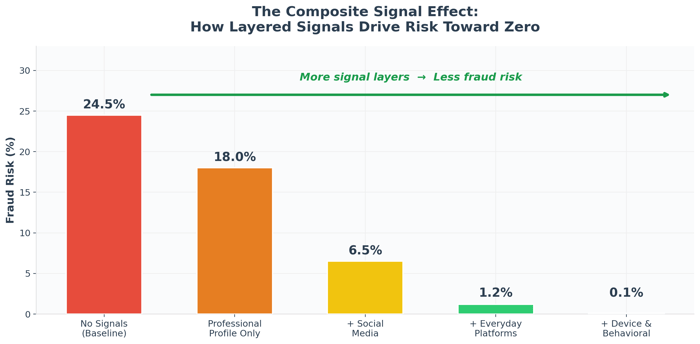 Signal layer importance in resume fraud detection
The Arms Race Continues
We publish findings like these because the industry needs to understand the threat landscape. But we're also intentional about what we share and what we don't. The specific platforms, weighting models, and signal combinations that power Tofu's applicant and resume fraud detection engine are proprietary - and they need to stay that way.
What we will say is this: the "humanness" signal is one of the most durable and predictive categories of fraud detection we've discovered. It's hard to game, it's resistant to automation, and it maps directly to the fundamental economics of identity fraud.
As always, bad actors will adapt. They'll start seeding everyday accounts into their fabricated identities. They'll try to buy aged accounts on more platforms. And when they do, we'll be ready with the next generation of signals.
That's the job. And we're just getting started.
If you're seeing suspicious applicants in your pipeline and want to understand how Tofu's resume fraud detection can help, reach out to our team. We're here to help you build security into every step of your recruiting funnel.
P.S: If you're just hearing about Tofu for the first time, visit hiretofu.com.
FAQs
What is applicant fraud detection and why does it matter?
Applicant fraud detection is the process of identifying fake candidates before they enter your recruiting funnel. With the rise of AI-generated resumes, stolen identities, and state-sponsored infiltration campaigns, companies are seeing fraudulent applicants at unprecedented rates. Effective applicant fraud detection goes beyond resume screening - it analyzes an applicant's full digital footprint to determine whether the person behind the application is who they claim to be.
How can recruiters identify fake candidates in their pipeline?
The most effective way to identify fake candidates is to look beyond the resume and professional profile. Fraudulent applicants typically build "sterile identities" - they have the professional accounts needed to apply for a job, but lack the everyday digital footprint that real people accumulate over years of normal life. Automated tools that cross-reference dozens of signals across an applicant's digital presence can flag suspicious profiles before they reach an interview. Stay away from one's that simply tell you 'the applicant has a strong digital footprint'. The best one's can actually tell you what those details are and prove it to you.
What is resume fraud detection and how is it different from traditional background checks?
Resume fraud detection focuses on verifying that the person applying is real and that their credentials are authentic - before you invest time interviewing them. Traditional background checks happen post-offer and typically verify employment history and criminal records. Resume fraud detection operates earlier in the funnel, using digital signals and behavioral analysis to catch fabricated identities, AI-generated resumes, and impersonation attempts that background checks were never designed to detect.
What is the "humanness" signal in recruiting fraud detection?
The "humanness" signal refers to the presence of everyday, non-professional digital accounts that real people naturally accumulate - the kind of platforms you use for daily life, not for getting hired. Our data shows that applicants with these accounts are overwhelmingly more likely to be legitimate, with clean rates ranging from 82% to 95%. Fraudulent identities almost never invest in building out this layer of their digital footprint, making it one of the most durable signals in recruiting fraud detection.
Can fake resume detection tools catch AI-generated applications?
Yes. Modern fake resume detection goes far beyond checking for copy-paste patterns or formatting inconsistencies. AI-generated resumes may look polished on the surface, but the identities behind them still exhibit the "sterile identity" pattern - professional profiles that exist in isolation without the broader digital presence that real applicants have. Advanced fraud detection platforms analyze this full picture rather than just the document itself.
How does applicant fraud detection work without slowing down hiring?
Effective applicant fraud detection runs in the background as applicants enter your pipeline. Platforms like Tofu analyze digital signals automatically and return a risk score within seconds, so recruiters can prioritize legitimate candidates without adding steps to the process. The goal is to remove fraudulent applicants before they consume recruiter time - not to add friction for real candidates.
What types of recruiting fraud should companies be most concerned about?
The biggest recruiting fraud threats today include identity theft (using stolen personal information to apply), professional impersonation (claiming someone else's work history), North Korean IT worker infiltration (state-sponsored operatives targeting remote roles), and AI-powered application farms that generate hundreds of fake candidates at scale. Recruiting fraud detection tools need to address all of these vectors simultaneously.
How can companies improve their ability to identify fake candidates at scale?
To identify fake candidates at scale, companies should implement automated screening that analyzes digital identity signals before the interview stage. Relying on manual review or gut instinct doesn't scale, especially when fraud operations are submitting hundreds of applications across multiple companies simultaneously. Composite and probabilistic scoring that layers multiple signal categories produces the most reliable results, reducing false positives while catching the vast majority of fraudulent applicants.