
We're launching real-time deepfake detection for interviews. Here's why, and how it works.
We've spent the last two years watching interview fraud and since January alone we've flagged 67,000 impersonation cases across our customers' pipelines, real professionals whose identities are being used by someone else to interview for jobs they never applied to. The people running these operations aren't padding resumes anymore, they're organized teams with deepfake stacks, remote desktop software, and proxies feeding answers over Discord. The resume is often the cleanest part of the application now, because it was stolen from someone real.
That's the problem we built Tofu's Deepfake Detection to solve.
What we built
Tofu's real-time deepfake detection is live, and it's built for the fraud we're actually seeing in 2026 rather than the 2024 version most detection tools are still solving for. We built this deepfake in a couple of minutes - watch it here. This is the bar now, and it's only getting better.
Tofu analyzes a combination of signals during every live interview - lip syncing, eye movement, facial construction, voice patterns, and hints of generative AI overlay, because no single one of them is reliable on its own against modern fraud stacks, but the combination becomes very hard to fake all at once without leaving traces somewhere.
One of the patterns our data surfaced that a single-call detector would miss is professional interview swapping - which is basically a skilled proxy that crushes the technical screen, the real "candidate" shows up for the behavioural round, then the proxy comes back for the final or some other variation of this.
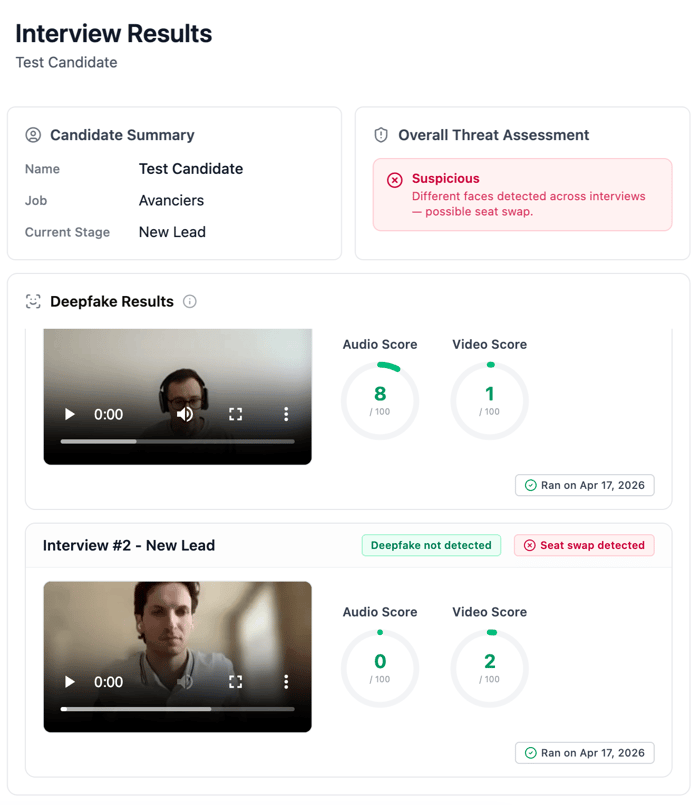
Catching that requires comparing signals across interviews rather than flagging a single suspicious call, which is why Tofu tracks physical appearance, voice, and behavioral patterns across every stage of the loop and raises a flag when the person in round three doesn't match the person in round one. We also surface location and device signals in real time, flagging when someone is interviewing from an unexpected country, routing through a VPN, or running suspicious background software.
A few product decisions worth calling out because they matter more than raw detection accuracy does. Tofu runs on the video stack you already use - Zoom, Google Meet, Microsoft Teams, Webex, GoTo Meeting, with nothing for the candidate to install and no extra step inserted into the interview, because a detection product that breaks the candidate experience is one your recruiters will quietly stop using. It also stays quiet until there's something worth surfacing, since the vast majority of your pipeline is real people applying to real jobs, and a tool that treats everyone as suspect is a tool nobody actually wants in the room.
Finally, Tofu is built to work as one layer in a stack rather than as a silver bullet, deepfake detection catches a specific class of fraud, resume fraud detection catches another, humanness scoring catches another, and the teams doing this well in 2026 are using all of them together, which is why Tofu plugs into the ATS and interview workflow you already have with native support for Greenhouse, Ashby, Lever, Gem, Workday, Oracle, and 42 more.
Every interview you run is an identity check whether you meant it to be one or not, and the people on the other side know that better than most hiring teams do. The question isn't whether deepfakes are in your pipeline - our data says they already are. It's whether you'll see them before they see an offer letter.